If you are still letting Airbnb decide how much to charge for your property, you are leaving thousands of dollars on the table every single quarter. The native “Smart Pricing” toggle is designed to do two specific jobs: guarantee a booking at almost any cost and encourage guests tell their friends about the great value they received on Airbnb. That works out beautifully for the platform and its transaction fees, but it leaves hosts with less than optimum rates, more demanding guests, depleted margins and forever missed opportunity cost.
To run a profitable short-term rental, you must take control of the incredible pricing opportunities available to you, not just leave your property on autopilot and hope for the best. It is about understanding supply, demand, and local booking curves to extract the absolute maximum value from every single night your property sits on the market.
Why Airbnb Smart Pricing is Costing You Thousands
To fix your pricing, you first need to understand why the platform’s built-in tool is not your friend. Airbnb operates on a volume-based business model. They take a percentage cut of every booking that occurs across millions of active listings.
Their primary financial goal is to maximize total transaction volume, which means keeping occupancy high across the entire platform. Whether your specific apartment rents for $320 a night or gets discounted down to $220 to secure an instant booking, Airbnb still gets paid. You, however, lose $100 of pure profit. Discounting can make sense under very specific circumstances, for example last minute availability or during a mid-week gap, though in our experience Airbnb is both too steep in their discounting and too aggressive in the dates they choose.
We are not the only ones noticing. Independent market data shows that Airbnb Smart Pricing routinely underprices listings by 15% to 30% compared to a competitor-relative strategy. It treats your property like a commodity, ignoring unique styling, premium finishes, and the exact localized micro-demands of your street. If you want to maximize your yield, the very first step is to turn that toggle off forever.
The Dynamic Pricing Framework: Outsmarting the Algorithm
Professional revenue management relies on dynamic pricing, the exact same methodology airlines and premium hotels use to constantly adjust rates based on real-time market signals. Rates should shift based on lead time, historical patterns, and localized competitor availability.
The ability to price your property based on market conditions each and every day is one of the strongest advantages of having a short-term rental. To execute this effectively without making it a full-time job, you need specialized software like PriceLabs, Wheelhouse or BeyondPricing. These tools do not rely on Airbnb’s internal incentives; they analyze broader market data to recommend rates that protect your margins.
Establishing Your Core Base Price and Comp Set
Your base price is the anchor for your entire calendar. To calculate it accurately, you cannot rely on broad, automatic software recommendations. The software has not been inside your property. It does not know it’s selling points, weaknesses and unique attributes over the competition. You do. You must build a highly targeted, manual competitive set (comp set) so you are benchmarking against the right properties.
- Filter by True Capacity. A 2-bedroom property sleeping 4 does not compete with a 2-bedroom property sleeping 8. Group your comp set by exact guest capacity, not just bedroom count.
- Algorithms are geographically blind. In coastal markets like the Gold Coast or Sunshine Coast, a property 200 meters back from the beach does not compete with a beachfront listing on the same street. Manually select competitors within your exact walkable pocket.
- Categorise your property honestly. If you have invested in professional styling, remove basic, budget, or flat-pack furnished listings from your comp set entirely. Likewise if your property has attributes, ie a view, parking or pool, that your competitors do not. Keeping them in your data pool will trick your pricing software into keeping your rate ceiling artificially low. You’d be surprised how much better a properly marketed property can perform to an identical property in the same street or building. Make sure you are comparing apples with apples.
Once your hyper-local comp set is established, use their median booked rate as your starting baseline. If your home sits in the premium tier, set your base price 15% to 30% above that median.
Setting this base rate is not a “set-and-forget” exercise. You must build a weekly habit of monitoring your calendar’s pacing against your competitors. If your comp set is booking out 30 days in advance and you are completely empty, your base is too high. Conversely, if you are fully booked months in advance while they are empty, your base is too low, and you are leaving easy money on the table. Make minor adjustments in 5% to 10% increments to dial in the sweet spot without triggering erratic algorithm behaviors.
Mastering Seasonality in East Coast Australia
A static pricing model fails because traveler behavior shifts dramatically throughout the year. On the East Coast of Australia, these shifts are highly regional and dictated by weather, school holidays, and specific events.
| Region | Peak Season (Premium Pricing) | Low Season (Value Pricing) | Key Revenue Driver |
| Gold Coast & Sunshine Coast | Dec – Jan (Summer school holidays, Easter) | Jun – Aug (Cooler winter months) | School holiday price multipliers, warm winter escapes |
| Melbourne | Oct – Mar (Spring Racing, Australian Open, Grand Prix) | Jun – Aug (Deep winter cold) | Major international sporting events, theater runs, corporate mid-week |
| Brisbane | Mar – Oct (Mild winter weather, major conferences & sporting events) | Dec – Jan (Guests leaving for the coast at Christmas, peak summer humidity and rain) | Mid-week corporate travel, major stadium events |
During peak summer on the Sunshine Coast or Gold Coast, demand is inelastic. Travelers have already committed to their holiday dates and are prepared to pay a premium. You should implement a seasonal multiplier that automatically increases your base rate by 30% to 50% for December and January bookings.
Conversely, for Melbourne in July, your strategy must pivot to capturing mid-week corporate bookings or weekend culture seekers. Lowering your base rate slightly while keeping your weekend premium intact keeps your calendar active without devaluing your listing.
This might sound scary but with the right approach or a competent property manager it is extremely achievable. Our portfolio is currently over 450 listings and we maintain well above 85% occupancy annualized for the year. A little knowledge and the right strategy goes a long way.
Dynamic Minimum-Stays
One of the most overlooked pricing levers by amateur hosts is the dynamic minimum-stay rule. Many hosts set a blanket “2-night minimum” and never change it. This leaves massive revenue gaps in your calendar.
If you require a 4-night stay during peak periods, you prevent guests from booking prime Friday and Saturday nights far in advance, which would otherwise leave the surrounding weekdays unbookable.
To optimise your occupancy rate and protect your weekends, apply this structured approach:
- Far-Out Bookings (30+ Days): Set a strict 3-to-5-night minimum stay. This captures high-value, longer holiday bookings early on.
- Near-Term Bookings (Within 14 Days): Automatically drop your minimum stay to 2 nights. This allows you to capture weekend getaways that were skipped over by longer-stay travelers.
- Orphan-Day Rules: If you have an empty Monday and Tuesday sandwiched between two weekend bookings, create an automated rule that allows a 1-night stay for those specific dates, but apply a 20% price premium to cover the higher operational turnover cost.
Monitoring Booking Pace and Adjusting on the Fly
Successful revenue management requires tracking your booking pace – how fast your calendar is filling up relative to the check-in date.
If you are 100% booked out for the next two months, your prices are too low. You have left easy money on the table. If you are 10 days away from a weekend and your calendar is completely blank, your rates are sitting too high for the current market.
Instead of panic-discounting manually, set up automated last-minute discounts that scale down gradually. For example, a 10% discount at 10 days out, moving to a 20% discount at 5 days out. This keeps your listing highly competitive in search rankings without dropping your rates to the bottom of the barrel the moment your calendar looks quiet.
Scaling Your Pricing Without the Burnout
Managing these variables across a single listing requires weekly audits, platform updates, and constant market monitoring. This is where professional management makes a measurable difference.
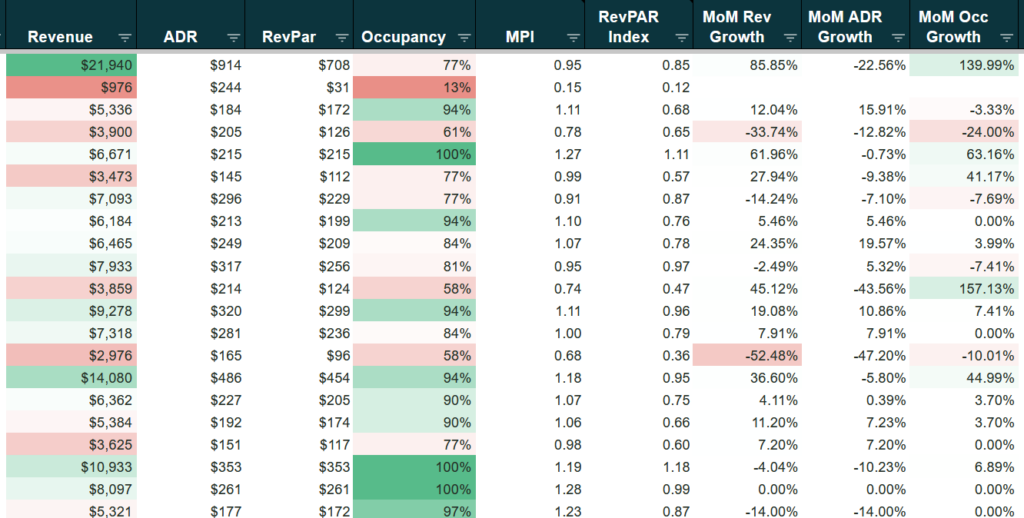
At Bedspoke, we combine advanced dynamic pricing technology with years of local market data to maximize your daily yield. We do not use lazy, automated platform settings. We build custom pricing profiles tailored to the exact street, layout, and target guest of your property. On top of this, our in-house revenue manager tracks your listing and its associated KPIs daily. We do not set and forget. It is not in your best interests nor is it in ours.
Here is an example of our tracking metrics:
Squeeze Every Cent From Your Listing
Pricing your Airbnb is not a static task you complete once and check off your list. It is an active, data-driven strategy that requires constant refinement. By ignoring Airbnb’s low-ball Smart Pricing recommendations, implementing dynamic stay restrictions, and adjusting your rates to match local Australian seasons, you can comfortably boost your yearly yields.
If you are ready to stop guessing your rates and want to see the true revenue potential of your property, connect with our team today for a straightforward, hassle-free property management consultation. We are a full-service option that removes all the pain points from operating a short-term rental. Cleaning, guest services, linen, revenue management, maintenance and more.